|
|
|
Cornelis Waardenburg DFC. Royal Air Force 320 (Dutch) Sqd. (d.30th Aug 1944) In May 1940, Cornelis Waardenburg fought within the Dutch Army, on the Grebbeberg, the most fierce part of the front in Holland. He was a Reserve-Second Lieutenant then.
He escaped to be a prisoner of war and flew to England.
He was with the 139 Squadron and received a DFC. I don't know the circumstances why.
Have you any information about him for me? He was a mate of my father during the fights on the Dutch front.
Thank you in advance.
|
A Waddell . British Army Border Regiment A Waddell served with the Border Regiment British Army. I have his unissued dogtags, made in preparation for deployment to the Far East and would love to get them home to his family. I am happy to cover all costs. If you are a family member or can put me in touch with them please get in touch. Update: Unfortunately The Wartime Memories Project has lost touch with Dan, his website, facebook page and email have all ceased to function. But if you can add any details about the person listed, please use the add to record link below.
|
Pte. George Waddell . British Army 1st Btn. Black Watch from Chorlton on Medlock (d.27th Mar 1945 ) George Waddell is the nephew of my grandfather Alexander Dutton, son of Lilly Dutton.
|
W/O. Peter Victor Waddell . Royal Australian Air Force 249 Squadron from Balwyn,, Victoria,, Australia (d.30th Mar 1944) Peter Waddell was the son of William Henry and Margaret Elizabeth Waddell of Balwyn, Victoria, Australia.
He was 25 when he died and was buried in the Tirana Park Memorial Cemetery, Albania. He is remembered on the Special Memorial E his grave having been lost.
|
LAC. Walter William Waddell . Royal Canadian Air Force 432 Squadron from Collingwood, Ontario, Canada
|
L/Cpl. Alan George Albert Waddington . British Army 5th Btn. Duke of Cornwalls Light Infantry from Surbiton, Surrey (d.18th Nov 1944) Alan Waddington was the uncle I never got to meet. He was my Dad's much loved older brother, some ten years older than Dad. Shortly before the attack in the forest where he was killed in 1944, Alan had received a letter from back home, saying that his wife had given birth to their first baby, a little boy, and he had written back saying how pleased he was to have become a father. He also asked that the baby boy be called David. This was the last letter he would write. Maybe it was just too painful for my heartbroken aunt to use that name, for some reason she decided instead to call the baby Leslie.
My grandmother told the family that my uncle was 'missing, presumed dead,' and my father (for a very long time) clung to the dream that maybe his brother would turn up one day (having been in hiding, or taken prisoner, or lost his memory). As the years went by, this seemed less and less likely.
When my parents had their first child in 1950, they knew straight away that they must call him Alan, after my Dad's brother.
It was only after my grandmother died in 1966 that, sorting through her possessions, the family found a much-read crumpled letter addressed to her, and written by a friend of my uncle's in November 1944 sent from the front. The letter said how sorry he was to have to tell her that he had witnessed her son being killed by an exploding shell, and that death would have been instant.
|
Isobel Waddon . Land Army My Grandmother, Isobel Waddon, died without disclosing much information about her time she spent in the land army. I would love to here from someone who served with her. I would like to hear their stories or see any photos they may have. She came from West Lulworth.
|
Sgt. Wade . Royal Air Force bomb aimer 101 Sqd.
|
AE Wade . British Army AE Wade served with the British Army. I have his unissued dogtags, made in preparation for deployment to the Far East and would love to get them home to his family. I am happy to cover all costs. If you are a family member or can put me in touch with them please get in touch. Update: Unfortunately The Wartime Memories Project has lost touch with Dan, his website, facebook page and email have all ceased to function. But if you can add any details about the person listed, please use the add to record link below.
|
AJ Wade . British Army Royal Armoured Corps AJ Wade served with the Royal Armoured Corps British Army. I have his unissued dogtags, made in preparation for deployment to the Far East and would love to get them home to his family. I am happy to cover all costs. If you are a family member or can put me in touch with them please get in touch. Update: Unfortunately The Wartime Memories Project has lost touch with Dan, his website, facebook page and email have all ceased to function. But if you can add any details about the person listed, please use the add to record link below.
|
CE Wade . British Army CE Wade served with the British Army. I have his unissued dogtags, made in preparation for deployment to the Far East and would love to get them home to his family. I am happy to cover all costs. If you are a family member or can put me in touch with them please get in touch. Update: Unfortunately The Wartime Memories Project has lost touch with Dan, his website, facebook page and email have all ceased to function. But if you can add any details about the person listed, please use the add to record link below.
|
Charles Wade . Royal Navy HMS Dorsetshire Does anybody remember my grandad, Charles Wade? He served with the Royal Navy with HMS Dorsetshire. He never spoke much about his time with the navy, but once a year he would recall how he got sunk and how he lost some good friends. Sadly he passed away about 12 years ago. I would be grateful for any info about my grandad.
|
F/Lt. Desmond Percy "Buster" Wade . Royal Air Force 33 Squadron from Canterbury, Kent. (d.23rd May 1942) Desmond Wade was the brother of my late mother's friend Sheila M. Wade who lived in the Saint Stephen's area of Canterbury, Kent. 'Buster' Wade was a pupil at the Kings School, Canterbury as a Day Boy because he lived nearby.
He signed up for RAF duty in his early 20s and became a pilot and served with the 247 British China Squadron and 33 Squadron and was for a while at an air station in Cornwall and at Roborough, Devon.
He was shot down in the Western Desert while flying a Hawker Hurricane on May 23rd 1942. Further details are in the archive of Kings School, Canterbury. I was the executor of Sheila's will when she died some years ago and I inherited much of her personal belongings including some of the details of 'Buster's' RAF service.
As I am now retired and these pieces of memorabilia of a non-relation who died before I was born are of no personal significance to me, I have decided to donate them, including his posthumous war service medals, to Kings School, Canterbury archives on 23/05/2014 the anniversary of his death 72 years ago
|
EE Wade . British Army Suffolk Regiment EE Wade served with the Suffolk Regiment British Army. I have his unissued dogtags, made in preparation for deployment to the Far East and would love to get them home to his family. I am happy to cover all costs. If you are a family member or can put me in touch with them please get in touch. Update: Unfortunately The Wartime Memories Project has lost touch with Dan, his website, facebook page and email have all ceased to function. But if you can add any details about the person listed, please use the add to record link below.
|
Sergeant Frederick William Wade . British Army Reconnaissance Corps from Willesden NW10
|
Sgt. Frederick Francis William Wade . British Army 56th Recce Reg. Reconnaissance Corps from Willesden, Middlesex. England. This is my husband's Uncle, Frederick Wade. He was captured in 1942 in North Africa, we believe in very early December, and remained a Prisoner of War until the war ended. When he returned home to England he was in a very poor state of health. He married in 1950 but only 3 months later died from Meningitis, an illness he had no strength to battle. He was the youngest of 8 children and was hugely missed by his Father, brothers and sisters and is still remembered with great fondness by his nephew, my husband.
|
George Chaplin Wade . Royal Navy HMS Philoctotes
|
Pte. Harrry Wade . British Army 5th Btn. East Yorkshire Regiment from Sheffield Yorks (d.6th Apr 1943) As my Father Harry Wade died when I was only 6yrs old I cannot remember too much about him unfortunately. He had worked on the railway in Sheffield but joined up in 1940 I expect thinking it was the right thing to do.
When he died my sister Maureen was 8yrs old, I was 6yrs & my brother Keith Harry was just 3 months old. There is so much to tell that I can barely start. My Mother naturally was devastated & without the help of friends & family I don't believe she could have found the courage to carry on & care for us children! We lived in a very poor house called a
"cellar kitchen" house where the living room / kitchen was downstairs a
front room above, a bedroom above that & topped by an attic. Right in the very centre of Sheffield so we had lots of bombing raids & many rushes out to the communal shelter which was shared by 8 families What with air raids & strict rationing it must have been a nightmare for my Mother!
I have lots of stories about my Dad gleaned mostly from the fantastic few letters which my Mom kept in a leather handbag my Dad had sent her from Egypt. It is impossible to read these letters without getting tearful. So beautiful & So full of Great Love
One of the most heart breaking ones is dated the day prior to his death!
Even more special is that it was just to his "Pets" his children saying how one happy day we would be together again. I could go on for instance about the time the enemy had them "pinned down" & one of their sergeants got wounded. My Dad & his comrades Carried their Sgt 4 miles through a minefield to get him to help. All this courage hidden away in old letters.
My Fathers life ended in a place called Wadi Akarit in Tunisia One of the
fiercest battles of the war rivaling El Alamain, Dad is buried at Sfax War Cemetery in Tunisia & me & my family have visited him there twice.
|
Pte. Harry Wade . British Army 5th Btn East Yorkshire Regt. from Sheffield (d.6th Apr 1943) My Great Uncle Harry. I would like to find any photos but none found as of yet, I want to know about him but feel I never will.
|
J Wade . British Army J Wade served with the British Army. I have his unissued dogtags, made in preparation for deployment to the Far East and would love to get them home to his family. I am happy to cover all costs. If you are a family member or can put me in touch with them please get in touch. Update: Unfortunately The Wartime Memories Project has lost touch with Dan, his website, facebook page and email have all ceased to function. But if you can add any details about the person listed, please use the add to record link below.
|
Joseph Patrick Aloysisus Wade DFC. Royal Air Force
|
Flight Sergeant Peter Stuart Wade . RAAF (d.25th May 1944) During the second World War the Allied and German soldiers, who were killed in Goirle, Noord Brabant, the Netherlands and in the neighbourhood, were buried at the Roman Catholic cemetery from the parish St. Jan in Goirle.
After the war the remains of the German soldiers were reburied in Ysselsteijn (near Venray) and most of the allied soldiers were reburied in Bergen op Zoom (War Cemetery and Canadian War Cemetery) and in Leopoldsburg (Belgium, War Cemetery).
At this moment there are 27 Allied graves in Goirle. Every year we commemorate the victims of World War II, both soldiers and civilians. We know their names, but who were the persons behind the names? What were their lives before they died? Where did they come from? How did they die? Under what circumstances?
It is my intention to give the victims a face, to write and keep the story behind the gravestones because we always will remember the soldier who died for our liberty. We can forget names, but not faces. I will try to write down all their stories for the next generation so they will know who was commemorated.
Maybe someone can help me with Flight Sergeant Peter Stuart Wade RAAF 426719 who died on the 25th May 1944, age 23.
Send me a letter or an e-mail with additional information, a photograph or a copy of any personal document, which I can use for The Memory Book or a website. Thank you in advance for your help.
|
Flight Lieutenant R P Wade . RAF VR 59 Squadron
|
ST Wade . British Army Royal Ulster Rifles ST Wade served with the Royal Ulster Rifles British Army. I have his unissued dogtags, made in preparation for deployment to the Far East and would love to get them home to his family. I am happy to cover all costs. If you are a family member or can put me in touch with them please get in touch. Update: Unfortunately The Wartime Memories Project has lost touch with Dan, his website, facebook page and email have all ceased to function. But if you can add any details about the person listed, please use the add to record link below.
|
P/O George "Geordie " Wade. . 24 Operation Training Unit I Flew With The Canadians
I was called up into the RAF from Durham University Air Squadron on 9th May 1942 as an aircrew trainee aged 19½ years of age, and spent three weeks of induction at ACRC London living in Avenue Close, St John’s Wood. There followed three weeks in the Metropole Hotel in Brighton before posting to No 9 EFTS, Ansty, Warwickshire for the aircrew grading course. This involved 12 hours dual instruction in DH82A “Tiger Moth” aircraft in which we did “the whole business” of flying, up to spins and recovery from spin. I absolutely loved it but I failed to go solo.
From there we went to Heaton Park, Manchester where we lived in small ridge tents awaiting our new gradings. I was to become a Bomb Aimer (officially Air Bomber).
After seven weeks, many of us were sent to Marine Court, St Leonards on Sea (9½ hours by train) to wait for posting to training units. I was on the 12th floor and lifts were not operating! I became very fit going up and down the stairs several times a day for four weeks.
The building was attacked twice by cross-channel Me109 and FW190 fighter bombers and on the second occasion it was slightly damaged, so we went back to Heaton Park via Harrogate (9 hours). One week later we travelled to Gourock (10 hours by train) to board RMS Queen Mary. There were 18 to a cabin and only 2 meals a day. These were meals like pre-war food because these troopships stocked up in the USA. We had actual white bread (unlike the National Loaf at home) and sausages with meat in them!
On board we could buy plenty of Coke and chocolate and cigarettes were 2/6d for 200. After landing at Boston, Mass, we took the train up to Moncton, NB through the brilliant autumn colours of New England. 4 days later it was a CNR train journey across Canada via Lake Superior and the prairies to No 5 Bombing and Gunnery School at Dafoe, Sask. On completing that course we were posted to No 1 Central Navigation School at Rivers, Manitoba on New Year’s Eve 1942. There we did cross-country flights (map reading and bombing for me) in temperatures at night as low as -40ºC. The engines of the Avro Ansons had to have their oil diluted with petrol to facilitate starting in those freezing conditions.
There were individual ice crystals falling from the sky and the Northern Lights were spectacular. Completion of that course saw us on Wings parade and promoted to Sergeant. Then it was CPR train back to Moncton with a stopover at Montreal. At Moncton I was promoted to Pilot Officer and given $180 for kitting out (at T. Eaton Co). Soon afterwards it was train down to New York to board RMS Queen Elizabeth for the trip back to the Clyde. This time the cabin accommodation was the same as on the trip out but being an officer, I had meals in the first class saloon served by stewards. Both trips across the Atlantic were by Southern latitudes to avoid the U-boat packs in the North.
Back in the UK there was more bombing, gunnery, astro-navigation, map reading and signals at No 1 (O) AFU at Wigtown near Newton Stewart in the South West of Scotland. Then more of the same at No 24 OTU at Honeybourne, Gloucestershire where crews were formed.
I crewed up with Sgt RC Reinelt (Pilot), Sgt “Johnny” ARW Hardes (Nav), Sgt DH Williams (W/Op A/G) and RCAF Sgt G Dykes (A/G). After that it was a move to 6 Group RCAF, starting at 1659 Heavy Conversion Unit at Topcliffe where we trained on old MKI Halifaxes and on 16th September 1943, I celebrated my 21st birthday. We went on to RCAF Squadron 429 at Leeming having picked up a F/Eng Sgt JE Peppercorn and a mid-upper gunner RCAF Sgt “Curly” Shields making a crew of seven.
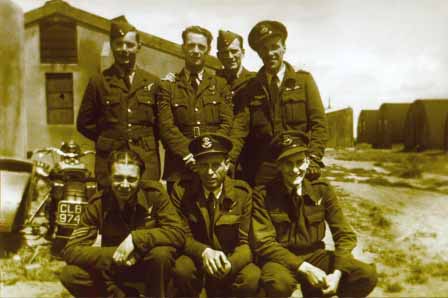
Crew of Q Queenie at Skipton on Swale, 433 Squadron April 1944
Back Row Left to Right:
Sgt DE Carruthers, M-U Gunner RCAF.
Sgt DH Williams, W/Op A/G RAF.
Sgt ARW Hardes, Nav RAF.
P/O RC Reinelt, pilot RAF.
Front Row Left to Rig:
Sgt JE Peppercorn, FL Eng RAF.
P/O G Dykes, Rear Gunner RCAF.
F/O GM Wade, Bomb Aimer RAF.
At 429 Squadron (Motto : FORTUNAE NIHIL – nothing to chance) led by W/Cdr Patterson DFC (known to us as “2650 + 4” because of his insistence on such revs and boost for economical cruising), we flew Halifax MK II’s. Although we were based at Leeming we actually flew from Skipton-on-Swale.
When we, as a crew, had done four ops we were posted to Skipton as part of the nucleus of five crews to start 433 Squadron (Motto : QUI S’Y FROTTE S’Y PIQUE” = whoever rubs himself there will be pricked there) – the Porcupine Squadron. One crew piloted by RCAF P/O Chris Nielsen (nicknamed “the mad Dane”) had done 15 ops and so were very experienced.
At Skipton we flew Halifax Mk III’s under the leadership of W/C Clive Sinton DFS, a superb CO, and the aircraft were totally trustworthy and good performers. In a tragic accident in late December 1943 an aircraft piloted by F/O PR Humphries was taking off at Skipton and crashed on to our aircraft which was parked at dispersal. The five crew members and two ground crew members were all killed and both planes were destroyed in the resulting blaze. Since I was the only officer in our crew at the time, I was appointed officer in charge of the escort party at the funeral of these seven men. The funeral took place in Harrogate on Christmas Eve which was a very frosty day. It was a truly miserable occasion. I cannot imagine what was put in the coffins since both planes were reduced to ashes. Normally each carried 1800 gallons of petrol plus ammunition for the guns, and some flares.
I trained on H2S and Gee, while the Squadron was expanding, and my task apart from bombing was to take and log fixes every two minutes when possible, sitting alongside the navigator. I assisted the pilot with engine controls on take off and landing and took over from him occasionally especially on training flights and returns from operations. I was also expected to be emergency pilot as well as deputising for other crew members, should the need arise.
At an early stage at 433 Squadron “Curly” Shields went back to Canada and we were joined by RCAF Sgt Doug Carruthers as Mid-Upper Gunner. Three of the five crews who formed the nucleus of 433 Squadron were soon lost on ops leaving Chris Nielsen’s crew and ours. Sadly Chris and his crew were shot down just short of the target on their 27th op. and at least one of the crew, F/Eng P/O Christopher Panton, was killed. This was the disastrous raid on Nuremberg (30th/31st March 1944) when 95 aircraft were lost. It was nearly 96 because we were attacked by a Me210 just after leaving the target. We lost an engine and two fuel tanks when we were hit by 3 cannon shells which resulted in a fire in the wing. We were able to make the trip back to Englnd landing at Manston in Kent. This was our 15th operation.
The skipper was commissioned and received an immediate DFC. The rest of the crew were commissioned later and then the Navigator and both Gunners received DFC’s.
Almost half of our raids lasted between 6 and 8¼ hours and the rest were from about 3 to 6 hours. After D-day most operations were daylight ops to Northern France. The sky seemed full of aircraft all around, which we had not been aware of in the dark.
Instead of the full 30 ops for a tour, I was allowed to finish on 29 having been in Station Sick Quarters (when the rest of the crew went to Berlin) because of a very bad cold! This was not really surprising seeing that we lived in cold Nissen huts, the crudest accommodation we could have had, other than tents.
Incidentally, Chris Nielsen’s F/Eng Christopher Panton, who was killed, has been commemorated by the establishment of the Lincolnshire Aviation Heritage Centre by his two younger brothers, near Spilsby, Lincolnshire.
Also it may not be well known that only one crew out of three completed a tour of 30 ops without being shot down or lost in some other way.
Having completed my tour in June 1944 I was posted to a number of OTU’s as bombing instructor then went on to BDU, Feltwell and CBE Marham in Norfolk. Marham was the last of my active service stations before demob in August 1946. I went back to University to finish my degree in Electrical Engineering, extremely relieved to have survived my time in the RAF and glad to have flown with the Canadians.
|
Sgt M. Wade. . Sgt Wade was a Bomb Aimer killed on Ops in Nov 43.
|
ARC Wadeson . British Army ARC Wadeson served with the British Army. I have his unissued dogtags, made in preparation for deployment to the Far East and would love to get them home to his family. I am happy to cover all costs. If you are a family member or can put me in touch with them please get in touch. Update: Unfortunately The Wartime Memories Project has lost touch with Dan, his website, facebook page and email have all ceased to function. But if you can add any details about the person listed, please use the add to record link below.
|
|