|
|
|
Torp. Angela "Scotty" Vaghi . Women's Royal Naval Service from Edinburgh My mother, Angela Vaghi, joined the Wrens in 1941 at the age of 18. She volunteered to be in the first group of women in the Naval Service to undertake men's work and became a Torpedo Wren working on servicing and replenishing torpedoes and depth charges on the ships escorting the Atlantic convoys. She was based in Larne in Northern Ireland. The attraction, she said, was that they received sixpence a day danger money and were issued with men's uniforms to preserve their modesty when clambering around ships and submarines.
|
Gilbert William Vail . Auxiliary Fire Service from Surbiton 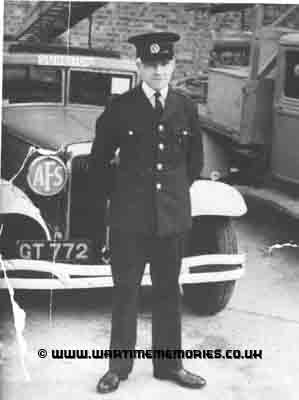 My paternal grandfather, Gilbert William Vail, lived in Surbiton all his life. He worked on the railway when he first left school and had a number of other jobs, including a motor fitter and general handiman. He was born in the early 1900's. Thus in the 1930's when rumours of a pending war where in the air he was of an age that he could be called up. He, and his brothers-in-law, believed that war was inevitable and came up with a plan.
It was quiet simple, if they were in a reserved occupation they could avoid being called-up! So he volunteered to become retained firemen. My grandfather's house was very near the fire station and thus he could cycle there in good time. A bell was installed in the house in Richmond Grove via a line from the GPO pole. Presumably he had another job as well.
Sure enough war was declared and the retained firemen became fulltime. My grandfather became fulltime in 1937/38, and received nearly £4 per week, a good wage then. Gilbert helped train recruits for the Auxiliary Fire Service. He was a trained motor fitter and served at the Brigade workshop at the Cattle Market at Kingston. He was also stationed at Godalming in Surrey and Norwich in Norfolk. He returned to Surbiton Fire Station on normal duties in 1945. He and his brothers-in-law were not asked to do military service.
There was one small problem with their cunning plan, London was to become one of the most dangerous places to live. Its civilian population were in the frontline. Surbiton and the surrounding towns were hit on a number of occasions. He fought fires all over London and presumably lost some of his colleagues.
Fighting fires and dealing with incidents in all weathers, often for long periods of time, took its toll. He developed asthma, for which there was not any affective treatment. He died in 1949 of a heart attack. I was born in 1958 and thus never met him but I do have photos of him in his uniform at Surbiton Fire Station.
His wife Bessie lived until she was 99 years old and carried photos of him. She was visited every Christmas by serving fire fighters. I am grateful that his work and widow were not forgotten.
|
Sgt. James Wentworth Vail . United States Army 93rd Armored from Camas, Wa My father James Vail served with the 93rd Armored Division, he was awarded the silver star and bronze star.
|
Leonard Valance . Leonard Valance is commemorated on the WW2 Roll of Honour Plaque in the entrance of Jarrow Town Hall.
|
William Valance . Royal Air Force 460 Sqd. Bill Valance flew with 460 Sqd as a rear gunner.
|
Cox. Basil Peter Valaris . HMS Snapdragon Basil Valaris was my father. He was seconded to the Snapdragon from the Greek Navy which he joined at the start of the war whilst living in Alexandria, Egypt. He told the story of throwing the cook overboard once because the cook insisted on making soup when they were in rough waters.
He was amazed that the entire ship would come to a virtual standstill when it was tea-time. He operated the ack-ack and was told to leave everything and come in for tea. Although he was Greek he loved the British and after the war became a British Citizen when he moved to his uncle's coffee farm in Tanzania.
|
Billy Vale . Home Guard Feltwell Btn.
|
A/Capt. Edward John Vale CdeG.. British Army 1st Btn. Highland Light Infantry from Walthamstow, Essex Edward Vale was awarded the Croix de Guerre. His citation reads, This officer during the period 26th of June to 31st of August 1944 was the pioneer officer and at all times carried out his duties with a complete disregard for his own safety. In the Haut du Bosq area after having carried out a daylight reconnaissance of a minefield under fire on the nights of the 14th/14 and 15th/16th of July 1944 he personally supervised the lifting of 615 British Anti Tank mines, many of the uncharted to allow armour to attack, During this period not only did he act with great energy and initiative but had to go without proper rest, personally delousing mines and booby traps that were too dangerous to entrust to others.
During the period 3rd to 5th of August 44 in the Missy
area when the Battalion had to advance through and
clear up a heavily mined area, he personally led
the necessary reconnaissance and want without
rest to supervise the lifting by his Platoon of 152
S mines, 590 Tellermines and an R mine
(the first of this then new type to be encountered) and plotted the remaning mined areas.
On 31st of August 9944 when the Battalion occupied Auxi-Le-Chateau, a bridge was captured intact but prepared for demolition. Not waiting for Sapper assistance and in the dark, he personally, having ensured all other personnel had withdrawal to a safe distance, drew the charges which consisted of 3 inverted Tellermines and 5 bazooka shells sunk in the road surface and about 50 lbs of explosive fixed under the arch, All the charges being wired together.
This bridge was of the greatest importance to the future advance of the Division and by his fearless conduct end skill he ensured that no harm should befall this vital link in communication,
This officerts technical skill allied with hia dauntless devotion
to duty and complete disregard for his personal safety have been an inspiration to all ranks.
|
Victor Arthur Vale . Royal Navy HMS Kashmir My father, Victor Arthur Vale, served on HMS Kashmir when she was on convoy duty.
|
Sgt. William Sidney "Chipper" Vale LdeH.. British Army 94th Field Regiment Royal Artillery from Birmingham
|
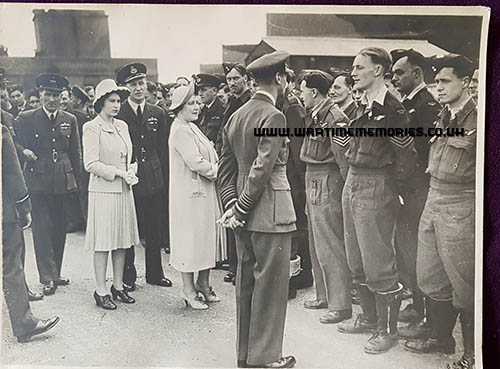
Cpl. Leah Valencia . Womens Auxiliary Air Force from London My mother, Leah Valencia was at RAF Methwold where she served with the Womens Auxiliary Air Force in WW2. I have found a number of photos, these include photos of her with other servicemen and women and a royal visit with Queen Elizabeth (Queen Mother) and our present Queen.
There are also documents:
Certificate of discharge,
RAF Service and Release book, Christmas Dinner menu for 1941
and an Invitation to a dance in the Sergeant's Mess in 1946.
Mother passed away in January 1999.
|
Sgt. Herman John "Wings" Valentine . US Army Air Force 323rd Bomb Squadron 91st Bomb Group from Canton, Ohio (d.9th Sep 1944) Herman Valentine was shot down on his first mission, on 9th of September 1944, after bombing the Skoda Works at Ludwigshaven, Germany in a B-17G named Strictly G.I. The airplane was severely damaged in its two right-side (starboard) engines, and the pilots' windscreen was blown out. The pilot, co-pilot, navigator, and bombardier were able to bail out safely and were captured immediately upon landing. The flight engineer/top turret gunner (Sgt. Valentine) and the other four gunners were not able to jump before the aircraft exploded.
|
Thomas Henry "Val" Valentine . Royal Air Force from Oxenhilme, Kendal Thomas Henry Valentine was called up in early 1941, having been waiting on deferred service since late 1940, and joined the RAF as Wireless Operator ACl, No. 1517358.
After initial training he was sent to Egypt and was involved in the push through to Libya. Before long he returned to Egypt whence he was sent to Palestine for further training ready for the assault on the Greek islands as part of an Advanced Landing Ground Party. At the end of September 1943 he was flown to the island of Kos in a Dakota.
Sadly the invasion of Rhodes did not go according to plan and the Allies were unable to establish air supremacy over the area, with the result that the Germans counter attacked on 5th October, 1943. Kos is a very small island and (as my father put it) with "nowhere to run" the allied forces were largely captured within the week. They were held for a short time in the castle on Kos whilst awaiting transport to the mainland of Greece, where they were marched to Athens. Here my father temporarily lost contact with many of his comrades due to sickness and being confined to a series of hospitals.
Next followed a 14 day train journey to the Dulag Luft interrogation centre for RAF personnel, and finally the arrival at Stalag IVB in December 1943. His prisoner number was 263514.
|
Pte. Thomas Earnest Valler . British Army 10th Btn. Highland Light Infantry from Dunstable (d.24th August 1944) We would like to remember Thomas Valler who fought with the 10th Battalion, Highland Light Infantry in WW2. He went to Normandy to defend his country and sadly lost his life at a young age on the 24th of August 1944. Thomas is buried Dunstable Cemetery in Bedfordshire.
|
LACW Daisy L.W. Vallis . Royal Canadian Air Force (Women's Division) from Devonshire, Bermuda (d.5th May 1946) Leading Aircraftwoman Vallis was the daughter of Clive Valentine Selby and Edith Beatrice Vallis, of Devonshire, Bermuda.
She was 28 when she died and is buried in the Pembroke (St John) Churchyard in Bermuda.
Daisy Vallis was the only Bermudian woman killed as the result of WW2. She was killed on her way to be demobbed. She was a Leading Aircraftwoman of the Royal Canadian Air Force (Women's Division).
|
Cpl. Arie van . Dutch Army
|
PFC. Charles Edgar Van . United States Army H Coy. 310th Infantry Regiment from Somerville, New Jersey My uncle Charles "Ed" Van Lieu was a machine gunner in company H, 310 infantry regiment. A few days before the regiment helped take the bridge at Remagen, he and his assistant gunner were sent in a jeep to set up their gun in a town which was believed to have been abandoned by the German Army. On reaching the town they parked and were looking around for the best place to put their MG when a German 88 started to fire on them. A round landed well down the street, then started to move towards them. Uncle Charles thought there was a spotter somewhere directing it onto them.
They both broke for the nearest door, my uncle in front. It was locked. As they pressed on it, a shell hit the eaves of the building over their heads. A piece of shrapnel went through his assistant (killing him), then through my uncle's pack, and into his butt. At the same time he was blown through the door.
He awoke in a cellar with ersatz coal, and some stairs going up to a door into the house. He crawled over to the door, and heard someone on the other side. He drew his .45 and knocked. The door opened, and there in front of his face were German army jackboots. Without looking up, he fired his pistol, hitting the man between the eyes, and driving the German back, where he ended up sitting on the stove, dead. Then he saw the man must have been a deserter or invalided, because he was in civilian clothing except for the boots.
He awoke again sometime later being carried out to a jeep by medics. He was taken to an aid station in a low building, part of a farm. After his wound was given treatment, he was put onto a Weasel, a jeep-sized tracked vehicle with racks for six stretchers. As they drove away, a German 88 shell hit the aid station and destroyed it.
Then the shells were directed down the road after the Weasel. My uncle was on his stomach facing the rear, watching as the shells got closer... then the road turned, the shells went straight, and his adventures for the next several weeks were over.
|
Gerard Henri Marie Van . Dutch Army MW 2eKl from Holland
|
Sgt. Hendrik Van . Royal Dutch Marines from Holland
|
Pte. Lawrence Arthur Van . United States Army H Coy 157th Infantry Regiment from Summit County, Ohio
|
Cpl. Willem Van . Dutch Army from Holland
|
F/O Willem Jacob van . Royal Canadian Air Force 10 Sqd. (d.10th Jun 1944) Willem van Stockum is my mother's brother. He was the person who introduced my parents in 1932. He died in 1944 and my father told my mother "the wrong man came back", meaning that Willem was more important to her than he was, and that his bravery made him the one who deserved to come home. He was Dutch.
A book has been written about Willem Time Bomber by an Army Major and pediatrician, Dr. Robert Wack.
|
A/Sqd.Ldr. Ralph Van Den Bok DFC.. Royal Air Force Volunteer Reserve "B" Flight (CO) No. 214 (FMS) Sqdn from East Horsley, Surrey Further to my researches into the service career of this interesting and remarkable man, with whom my father flew a number of missions or "Ops" in 1944/45,I now have something approaching a proper "story".
Ralph Van Den Bok was born in London, in about 1907, of a Dutch father and Australian mother. After school, he attended Dulwich College, and by the outbreak of WW2, was working at the London Stock Exchange. In 1940,he applied to join the RAFVR, and was granted a commission as a Pilot Officer on Probation (July,1940). After training as a Wireless Operator/Air Gunner, Ralph joined No.408 (Goose) Squadron of the Royal Canadian Air Force, with whom he flew 30 Operations as a "Wireless Air Gunner ", to use RCAF parlance.
In August 1941, Ralph was "Gazetted" as a Flying Officer, and continued to serve with No.408 Sqdn, rising to become a leader , and so always flying with the Squadron Commanding Officer, Wing Commander John D Twigg, RCAF. In the summer of 1942, following a brave but unsuccessful attack on the German cruiser "Scharnhorst", and having exhibited outstanding devotion to operational flying, Ralph was awarded his first DFC (Gazetted August 1942, at which time he was also Gazetted as a Flight Lieutenant). Within a few weeks, however, Ralph's aircraft, a Handley-Page Hampden, was shot down over Belgium, returning from a mission to bomb Saarbrucken, by Luftwaffe night-fighter "Ace" Hauptmann Wilhelm Herget in a JU 88. The pilot Wing Commander Twigg and the rear gunner, Flt/Lt Maitland DFC were killed, but Ralph and Flt/Lt Gordon Clayton Fisher, RCAF, baled out and after contacting Belgian esacape organisations , in Ralph's case "Comete" ,they returned to the UK. Ralph was then awarded a second DFC, Gazetted November 1942.
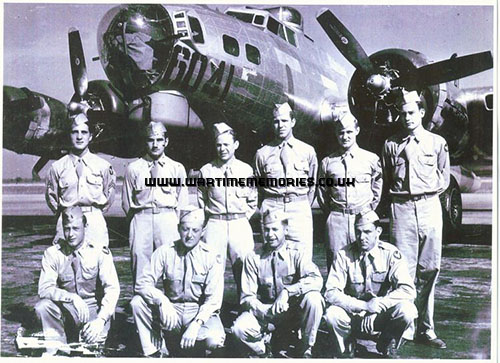
Ralph was then accepted for training as a pilot,and was sent to Hagersville, Ontario, Canada,where he was awarded his wings, aged 38. Returning to Britain, he joined No. 12 OTU at Chipping Warden, where he "crewed up" with my father, then Flt/Sgt John Mills RAFVR, who became Ralph's Wireless Op/Air Gunner, they first flew together in Wellington bombers in June 1944. After further training in Stirlings of 1657 Conversion Unit, they became "operational" with No.214 (Federated Malay States) Squadron, which flew Radio Counter-Measures (radio/radar jamming) sorties using Boeing B 17 "Flying Fortress" aircraft, from RAF Oulton in Norfolk.
In January 1945, Ralph was promoted to Acting Squadron Leader,and became Commanding Officer of "B" Flight of No.214 Squadron.By the end of hostilities,in May 1945, Ralph had flown a further 17 "Operations",and had exhibited such qualities of leadership and devotion to duty that he was awarded his third DFC ,in October (Gazetted November 1945). He remained in the RAF,in the rank of Flight Lt. for many years after the war, resigning his commission (as a Sqd/Ldr) in the Reserve in 1955. After flying a Proctor for a while with Standard Oil (ESSO), Ralph was, sadly, badly hurt in the Lewisham Rail Disaster of 1957, losing a leg to gangrene. He died in Salisbury in 1976.
I am deeply indebted to Adrian Van Den Bok, in Australia,for all the information he has provided about the life of his admirable and inspirational father, without whose skill and professionalism I would not be here today to write this tribute.
|
WO1 G. van Alphen . South African Air Force 15 Sqdn. from Transvaal (d.23rd February 1944) On 23rd February 1944 a Baltimore from 15 Sqdn RAF (235 Wing, 201 Group) was shot down by five ME 109 fighters off Dhia island, Crete. The aircraft was on a long-range shipping reconnaissance off Iraklion Bay, Greece and failed to return to base. The crew were:
Lt. C.P. Peachey, 180275V, Pilot.
Lt. Neville St. Ledger Seaton, 547404V
W/O 1. O.C. Spargo, 544027V, WOp/AG.
W/O 1 G. van Alphen, 572187V, WOp/AG.
All the crew were lost and are commemorated on the Alamein Memorial.
|
Gi Sld David Van Altena . Dutch Army from Holland POW Camp Fukuoka 17 in Japan
|
Cadet Cato Van Ardenne . Dutch Army from Holland POW Camp Fukuoka 17 in Japan
|
F/Lt. John Noel Charles Marie Joseph Van Daele . Royal Air Force Volunteer Reserve No. 609 (West Riding) Squadron Royal Air Force (d.28th Sep 1944) Flight Lieutenant Van Daele is buried in the Alblasserdam General Cemetery, Zuid-Holland, The Netherlands.
|
A. E. Van Den Bogaert . Royal Air Force 320 (Netherlands) Squadron from Holland (d.11th Jan 1943) A E Van Den Bogeart, a Dutch national, served in the Royal Air Force with 320 (Netherlands) Squadron during WW2.
On the 11th January 1943 Hudson '863' of 320 Squadron was lost on a training flight over the Irish Sea.
It's crew members were:
- Off. A.E. Van Den Bogaert - Missing in Action.
- Off. F. Schut - Missing in Action.
- Cpl. B. Corporaal - Missing in Action.
- A.F. Post - Missing in Action.
|
Sqdn Ldr Ralph Van Den Bok DFC & 2Bar.. RAFVR 214 squadron I am most interested in Squadron Leader Ralph Van Den Bok, DFC & 2Bar. RAFVR, as my father, Flying Officer John Tudor Mills (Wop/AG), flew on Ops with him in Boeing B17 F & G aircraft of 214 Sqdn, based at RAF Oulton, Norfolk, part of 100 group, during 1944/45. Records of the squadron's activities are somewhat sparse, in view of what they did (ECM etc). I have been quite unable to determine S/Ldr Van Den Bok's nationality, although I suspect that he might have been Canadian,as he was awarded his first DFC in 1942, as a Flying Officer, whilst operating with 408 (Goose) Squadron, RCAF (although he himself was RAFVR). From bits and pieces that I have managed to unearth, I gather that he was shot down by Flak at some point and escaped through Belgium, but I don't know the details. 3 DFC's is quite an achievement, he was awarded one of them for "Devotion to operational flying", or words to that effect. I would really like to find out more about him.
|
Van Den Burg . Royal Air Force No. 320 (Netherlands) Squadron RAF from Holland On 9th August 1944 a RAF plane, a Mitchell FR143 NO-S of 320 squadron, ditched at sea at 11:44 hrs (GMT)
Crew Members were:
- Van Den Burg
- C.A.G. Pieters - WIA
- Sgt. Wams
- Sgt. Hoffman
All were saved by ASR Walrus
|
|