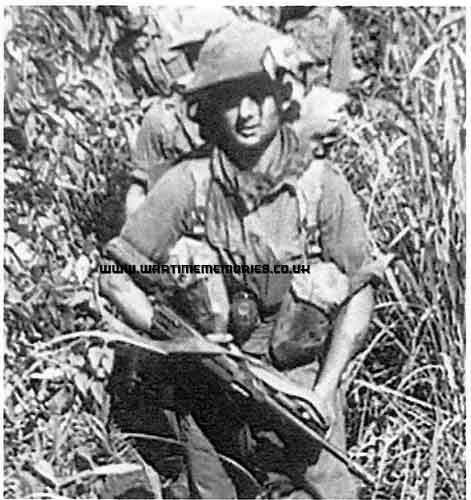
Pte. Charles Henry Talbot . British Army 9th Battalion, B Company Cameronian (Scottish Rifles) from Wednesbury, Staffordshire Charles Talbot was born 26.4.1926 and joined the army on the 20th of July 1944, training with the Gerneal Service Corps until 13th of September when he joined the East Lancasshire Regiment. On the 27th of February 1945 he was transferred to the 9th Battlion, Cameronians (Scottish Rifles). On the 21st of March 1946 he transferred to the Wiltshire Regiment then on the 20th of June to the Oxford and Buckinghshire Light Infantry. He was discharged on the 8th of March 1948.
|
Lt.Col. Dennis Blaquiere Talbot DSO, MC. British Army 5th Btn. Dorset Regiment from Barham, Kent Lt.Col. Dennis Talbot DSO, MC served with the 5th Btn, Dorset Regiment and 7th Btn, Royal Hampshire Regiment.
|
SJ Talbot . British Army Royal Armoured Corps SJ Talbot served with the Royal Armoured Corps British Army. I have his unissued dogtags, made in preparation for deployment to the Far East and would love to get them home to his family. I am happy to cover all costs. If you are a family member or can put me in touch with them please get in touch. Update: Unfortunately The Wartime Memories Project has lost touch with Dan, his website, facebook page and email have all ceased to function. But if you can add any details about the person listed, please use the add to record link below.
|
W Talbot . British Army 44th Btn. Royal Tank Regiment W Talbot served with the 44th Btn. Royal Tank Regiment British Army. I have his unissued dogtags, made in preparation for deployment to the Far East and would love to get them home to his family. I am happy to cover all costs. If you are a family member or can put me in touch with them please get in touch. Update: Unfortunately The Wartime Memories Project has lost touch with Dan, his website, facebook page and email have all ceased to function. But if you can add any details about the person listed, please use the add to record link below.
|
DC Talbott . British Army DC Talbott served with the British Army. I have his unissued dogtags, made in preparation for deployment to the Far East and would love to get them home to his family. I am happy to cover all costs. If you are a family member or can put me in touch with them please get in touch. Update: Unfortunately The Wartime Memories Project has lost touch with Dan, his website, facebook page and email have all ceased to function. But if you can add any details about the person listed, please use the add to record link below.
|
J. Talens . Civilian from Dutch East Indies During the Second World War I lived in the Dutch East Indies with my parents. My father was segeant engineer on board the cruiser SS Java. He died during the Battle of the Java Sea. My mother, elder brother, younger sister and myself with interned for three and a half years in Japanese internment camps.
After the war the so-called `Bersiap' period started and we were again put in the internment camps for our own protection. We were protected against attacks by the Indonesians, first by the Japanese and later by the British, Sikhs and Gurkhas. On 10th February 1946 were left the last internment camp to return to the Netherlands.
|
Pte. Herbert Talford . British Army 2nd Btn. West Yorkshire Regiment from Sheffield (d.13th Feb 1944) Herbert Talford died on 13th of February 1944 in Burma aged 25. He is buried in Taukkyan war cemetery. He was married to Constance and lived in Sheffield South Yorkshire. His father, also Herbert, served in WW1 in France and was also killed 5 weeks before the war ended.
|
Able Sea. John Tallant . Royal Navy HMS Nelson from Guildford My dad John Tallant, joined the battleship HMS Nelson in June 1943 aged 17 years and sailed to the Mediterranean for the Italian invasions. He remembers being on board on the 29th September 1943 when the dignitaries came aboard to sign the surrender of Italy including Generals Eisenhower and Alexander, Air Marshalls Tedder and Parks, Lord Got and General Badoglio from Italy. He was made AB and then torpedo man before going to Normandy on D-day plus 6.
He was then drafted to Ceylon to join HMS Woolwich where he became leading seamen & cox'n of a launch. He passed for petty officer and returned with the ship in July 1946. He is now 93 years old.
If anyone remembers him I would love to be in touch.
|
Pte. Edward Francis Tallent . British Army 7th Btn. South Staffordshire Regiment from Stafford My father, Ted Tallent, saw service in various countries. He was evacuated from Crete, was a Chindit in the first campaign and was part of Operation Doomsday in Norway in 1945. I have a certificate awarded to him by the King of Norway thanking him for his help in freeing Norway from the Germans.
My father kept a diary from his wartime action listing all the places he went to. Reproduced below are the details from his diary
The War Diary from the Second World War of 4919153 Private Edward Francis Tallent, South Staffordshire Regiment
Edward Francis Tallent, born 3rd August 1917 in Burton Upon Trent, died 21st September 1972 in Stafford.
His parents were Stephen Tallent and Edith Mary (Bird).
He had enlisted into the South Staffordshire Regiment embodied Territorial Army and posted to 7th Battalion on 18th January 1940. Enlistment details:
Address: 24 Young Avenue, Stafford. Trade on enlistment: Swimming Bath Attendant. Height: 5 ft 3 1/8 ins. Weight: 113 lbs. Chest: 34 ins.
Eye colour: Light Hazel. Hair colour: Dark Brown. Religion: Roman Catholic.
Training: Passed DM course July 1942. Specialist MT Driver November 1944
1940 Stationed at:
- Blundellsands
- Bromborough
- Rugeley
- Staindrop
- Darlington
- Hurworth-On-Tees
- Elton Park
- Wynyard Park
- 18th Jan Enlisted into the South Staffordshire Regiment embodied Territorial Army and posted to 7th Battalion.
- 26th Jul Admitted to Winterton Hospital.
- 6th Sep Discharged Winterton Hospital. Arrived Stafford.
- 14th Sep Left Stafford.
- 8th Oct Posted to Infantry Training Centre.
- 2nd Nov Draft leave.
- 9th Nov Returned from leave.
- 16th Dec Left Lichfield. Arrived Stafford.
- 24th Dec Left Stafford. Arrived Lichfield.
1941
- 4th Jan Left Lichfield.
- 5th Jan Posted to 1st Battalion. Arrived Liverpool. Arrived Seaforth. Embarked at Liverpool per S. S. J. 18 (Samaria).
- 6th Jan Left Docks. In Liverpool Bay.
- 10th Jan Left Liverpool Bay.
- 11th Jan Arrived Bangor Bay.
- 12th Jan Left Bangor Bay.
- 25th Jan Arrived Freetown.
- 29th Jan Left Freetown.
- 8th Feb Passed Capetown.
- 11th Feb Arrived Durban.
- 15th Feb Left Durban.
- 3rd Mar Arrived Port Tufik (Tewfik) (Suez).
- 9th Mar Disembarked Port Tufik (Tewfik). Arrived I.B.D. Geneifa.
- 23rd Mar Posted to 1st Battalion Argyll and Sutherland
Highlanders. Left I.B.D. Geneifa. Arrived at El Tahag.
- 28th Mar Left El Tahag.
- 30th Mar Arrived Kabret.
- 9th Apr Left Kabret.
- 10th Apr Arrived Mersa Matruh.
- 23rd Apr Left Mersa Matruh. Arrived Sidi Haneish.
- 24th Apr Left Sidi Haneish.
- 24th Apr Arrived Fuha Drome.
- 26th Apr Left Fuha Drome. Posted to 16th Infantry Brigade Anti-Tank Company. Arrived El Daba.
- 16th May Left El Daba.
- 17th May Arrived Ikingi Mariut. Left Ikingi Mariut. Arrived Alexandria. Arrived on Gun Boat.
- 18th May Rejoined Battalion. Embarked at Alexandria for Crete. Left Dock at 1.30am.
- 19th May Arrived at Crete.
- 29th May Evacuated on destroyer 'Jackal' from Heraklion.
- 30th May Disembarked at Alexandria from Crete. Left Alexandria.
- 31st May Arrived Sidi Bishr. Left Sidi Bishr.
- 9th Jun Posted to Infantry Base Depot.
- 31st Jul Posted to 1st Battalion South Staffordshire Regiment.
- 14th Aug Embarked Egypt as Ship's Anti-Aircraft Protection Party.
- 1st Sep Proceeded on Ship's Escort Duties.
- 12 Sep Rejoined Unit from Escort Duties.
- 1st Jun Arrived El Quasassin
- 7th Jun Left El Quasassin. Transferred back to I.B.D. Geneifa. Arrived Geneifa.
- 8th Jun Left Geneifa. Arrived Ismailia Leave.
- 11th Jun Left Ismailia. Arrived Geneifa.
- 30th Jul Left Geneifa.
- 31st Jul Arrived Alexandria (Mustapha). Joined the 1st Battalion South Staffordshire Regiment.
- 14th Aug Left Alexandria (Mustapha).
- 15th Aug Arrived Mersa Matruh (Boat Escort)
- 21st Aug Left Mersa Matruh (Boat Escort).
- 22nd Aug Arrived Alexandria (In Clink)
- 25th Aug Left Alexandria. Arrived Sidi Bishr.
- 1st Sep Left Sidi Bishr (Boat Escort).
- 3rd Sep Arrived Limassol, Cyprus.
- 9th Sep Left Limassol, Cyprus (Boat Escort)
- 11th Sep Arrived Alexandria.
- 12th Sep Left Alexandria. Arrived Sidi Bishr.
- 19th Sep Left Sidi Bishr. Admitted to 64 B.G.H.
- 29th Sep Left 64 B.G.H. Arrived Convalescant Camp.
- 18th Oct Left Convalescant Camp. Rejoined Battalion.
- 19th Oct Rejoined C Coy Mamura.
- 3rd Nov Left Mamura. Arrived Sidi Bishr.
- 17th Nov Left Sidi Bishr. Arrived Cairo. (Leave).
- 23rd Nov Left Cairo. Arrived Sidi Bishr. Left Sidi Bishr.
- 15th Dec Arrived Burg El Arab.
- 29th Dec Left Burg El Arab. Arrived Kam El Dik (Courier).
1942
- 14th Jan Left Kam El Dik. Arrived Amaria.
- 3rd Feb Left Amaria. Arrived Ikingi Mariut.
- 4th Feb Left Ikingi Mariut. Arrived El Quassasin
- 15th Feb Left El Quassasin. Arrived Abbassia (Cairo).
- 16th Feb Left Abbassia (Cairo). Arrived Massara (Turria).
- 22nd Feb Left Massara (Turria). Arrived Elwan. Left Elwan.
- 23rd Feb Arrived El Quassasin. Left El Quassasin.
- 24th Feb Arrived Suez Camp.
- 27th Feb Left Suez Camp. Embarked at Port Tewfik on Mauretania.
- 28th Feb Left Egypt.
- 6th Mar Arrived Bombay.
- 8th Mar Disembarked Bombay. Arrived Poona.
- 9th Apr Left Poona.
- 13th Apr Arrived Kunti.
- 3rd Aug Left Kunti.
- 4th Aug Arrived Calcutta. (Leave).
- 10th Aug Left Calcutta.
- 11th Aug Arrived Kunti.
- 19th Aug Left Kunti.
- 21st Aug Arrived Patna.
- 17th Sep Left Patna.
- 18th Sep Arrived Bhagalpur.
- 6th Oct Left Bhagalpur.
- 7th Oct Arrived Katihar.
- 21st Oct Left Katihar. Arrived Purnea.
- 28th Oct Left Purnea.
- 30th Oct Arrived Kunti.
1943
- 27th Jan Left Kunti.
- 28th Jan Arrived Daltonganj.
- 23rd Feb Left Daltonganj. Arrived Kunti.
- 15th Apr Left Kunti.
- 19th Apr Arrived Chittagong.
- 28th Apr Left Chittagong.
- 29th Apr Arrived Bariapur.
- 12th May Left Bariapur.
- 14th May Arrived Chittagong.
- 16th May Left Chittagong.
- 17th May Arrived Cox's Bazaar.
- 18th May Left Cox's Bazaar. Arrived Bawli Bazaar. Left Bawli Bazaar.
- 19th May Arrived Ramu Training Camp.
- 27th May Left Ramu Training Camp. Arrived Dassari. Admitted to C.C.S.
- 28th May Left Dassari.
- 29th May Arrived hospital Dacca.
- 19th Jun Left Dacca.
- 20th Jun Arrived Ranjiganj.
- 21st Jun Left Ranjiganj.
- 22nd Jun Arrived Calcutta.
- 23rd Jun Left Calcutta.
- 24th Jun Arrived Chittagong. Left Chittagong.
- 25th Jun Arrived Calcutta. Left Calcutta.
- 26th Jun Arrived Bariapur.
- 30th Jun Left Bariapur.
- 2nd Jul Arrived Nirsa.
- 3rd Jul Left Nirsa.
- 4th Jul Arrived Bariapur.
- 5th Jul Left Bariapur.
- 10th Jul Arrived Bangalore.
- 28th Aug Left Bangalore.
- 29th Aug Arrived Bombay.
- 12th Sep Left Bombay.
- 14th Sep Arrived Bangalore.
- 15th Sep Left Bangalore.
- 20th Sep Arrived Orcha.
- 14th Oct Left Orcha. Admitted to Jhansi British Military Hospital.
- 7th Nov Left Jhansi British Military Hospital. Arrived Orcha.
- 5th Dec Left Orcha. Arrived 21st B.G.H. Jhansi.
- 10th Dec left 21st B.G.H. Jhansi.
- 11th Dec Arrived Orcha.
1944
- 14th Jan Battalion left.
- 15th Jan Depot left.
- 23rd Apr Left Orcha. Arrived Agra.
- 24th Apr Left Agra.
- 25th Apr Arrived Delhi. Left Delhi.
- 25th Apr Arrived Dehra Dun.
- 20th May Left Dehra Dun. (Leave).
- 21st May Arrived Delhi. (Leave) Left Delhi. (Leave)
- 23rd May Arrived Bombay. (Leave)
- 7th Jun Left Bombay. (Leave)
- 8th Jun Arrived Delhi. (leave)
Left Delhi. (Leave)
- 9th Jun Arrived Dehra Dun. (Leave)
- 25th Aug Battalion arrived.
- 21st Oct Battalion left.
- 28th Oct Battalion left. Arrived Delhi.
- 29th Oct Left Delhi. Arrived Agra.
- 30th Oct Left Agra. Arrived Shivpuri.
- 31st Oct Left Shivpuri. Arrived Lalitpur.
- 1st Nov Left Lalitpur. Arrived Malthore Camp.
- 26th Nov Left Malthore Camp. (posted to Indian Transit Camp)
- 28th Nov Arrived Deolali.
- 6th Dec Left Deolali.
- 7th Dec On board Strathaird. (Embarked at Bombay per S.S. 32-P).
- 12th Dec Left Bombay.
- 19th Dec Arrived Port Suez.
- 25th Dec Left Port Suez. Arrived Port Said.
- 26th Dec Left Port Said.
1945
- 1st Jan Arrived Gibraltar.
- 2nd Jan Left Gibraltar.
- 6th Jan Arrived Liverpool.
- 7th Jan Arrived Isle Of Man.
- 8th Jan Left Isle Of Man. Disembarked at Liverpool.
- 9th Jan Posted to 23 Infantry Holding Battalion. Arrived Ross On Wye.
- 10th Jan Left Ross On Wye. Arrived Stafford (leave).
- 8th Feb Left Stafford. Arrived Ross On Wye.
- 28th Mar Left Ross On Wye. Arrived Woodhall Spa.
- 29th Mar Posted to 2nd Battalion.
- 31st Mar Left Woodhall Spa.
- 1st Apr Arrived Stafford. (Leave).
- 14th Apr Left Stafford. Arrived Woodhall Spa.
- 17th Apr Left Woodhall Spa. Arrived Slingsby.
- 28th Apr Left Slingsby. Arrived Chadacre Park.
- 9th May Left Chadacre Park. Arrived Woodhall Spa.
- 10th May Left Woodhall Spa. Arrived Grantham.
- 11th May Left Grantham. Arrived Banff.
- 12th May Left Banff. Flew to Norway. (Operation Doomsday)
- 13th May Arrived Norway. Arrived Oslo.
- 30th May Left Oslo. Arrived Eidsvolle.
- 19th Jul Left Eidsvolle. Arrived Trandum.
- 17th Aug Left Trandum. Arrived Alvick.
- 18th Aug Left Alvick.
- 19th Aug Arrived Bergen.
- 13th Sep Left Bergen. Arrived Oslo.
- 16th Sep Left Oslo. On board Suecia.
- 19th Sep Arrived Tilbury. Arrived Chiseldon Camp.
- 21st Sep Left Chiseldon Camp (Leave). Arrived Stafford.
- 8th Oct Left Stafford. Arrived Chiseldon Camp.
- 10th Oct Left Chiseldon Camp. Arrived Stafford. (Embarkation leave).
- 21st Oct Left Stafford. Arrived Chiseldon Camp.
- 2nd Nov Left Chiseldon Camp. Arrived Stafford.
- 6th Nov Left Stafford. Arrived Chiseldon.
- 11th Nov Left Chiseldon. (Compassionate leave). Arrived Stafford.
- 13th Nov Left Stafford. Arrived Chiseldon.
- 16th Dec Left Chiseldon. Arrived Dover. Left Dover.
- 17th Dec Arrived Ostend.
- 26th Dec Left Ostend.
- 27th Dec Arrived Harburg.
1946
- 28th Jan Left Harburg. Arrived Osnabruck.
- 29th Jan Left Osnabruck. Arrived Antwerp.
- 30th Jan Left Antwerp. Arrived Ostend.
- 7th Feb Left Ostend. Arrived Tournai.
- 8th Feb Left Tournai. Arrived Calais.
- 10th Feb Left Calais. Arrived Dover. Left Dover. Arrived Oxford.
- 11th Feb Left Oxford. Arrived Hereford. Left Hereford. Arrived Home, Demobbed.
- 3rd Jun Released to Army Reserve.
Medals awarded: 1939/45 Star, Africa Star, Burma Star, Defence Medal
War Medal 1939/45.
Testimonial on discharge: A very trustworthy, sober and intelligent man. He is a hard and willing worker, with a pleasing disposition. A very good driver.
Military conduct: Very Good.
|
John Tallentire . Royal Air Force Volunteer Reserve from Newcastle-upon-Tyne (d.31st July 1945) My father, Jack Tallentire was stationed at RAF Tilstock and was a navigator on a Welllington when it crashed at Press Higher Heath on the night of 31st July 1945. All the crew were killed.
|
Pte Eric Tallis . British Army Royal Warwickshire Regiment from Birmingham Eric Tallis spent 3.5 years in the British Army with the Royal Warwickshire Regiment.
On 6th of June 1944, at the age of 22, he was sent to France to fight on the beaches of Normandy during D-Day. Shortly after arriving, he was hit by a shell and suffered shrapnel wounds through both legs bringing the end to his service.
After the war, Eric went on to have 2 children and died in 1973 at the age of 51.
|
Sgt. Walter Gilbert "Joe" Talmer . British Army Royal Warwickshire Regiment from Lee Common We know Walter Talmer served with this regiment during the Second World War and was in Burma.
|
Ian Frank Tamagno DSO Bar. Royal Australian Air Force from Castlemaine. Vic
|
Pte. Amon Tambala . British Army 2nd Btn. King's African Rifles (d.11th October 1943) Private Tambala was buried in the Lubudi African Cemetery in the Congo, Grave 12.
|
Pte. Amon Tambala . British Army 2nd Btn. King's African Rifles (d.11th October 1943) Amon Tambala was buried in the Lubudi African Cemetery in the Congo, Grave 12.
|
Gnr. Harry Tambling . British Army 3 Medium Regt. Royal Artillery from Looe, Cornwall. (d.17th April 1945) Gunner Tambling was the son of Edwin and Emily Louisa Tambling of Looe, Cornwall.
He was 31 when he died in the Battle of Otterloe.
He is buried in the Ede (Otterlo) General Cemetery, Gelderland, The Netherlands.
|
Ross Leonard Tamplin . British Army Independant Tank Brigade from Caterham, Surrey
|
Able Seaman Frederick William Tancock . (d.2nd Dec 1940)
|
JA Tandy . British Army Royal Warwickshire Regiment JA Tandy served with the Royal Warwickshire Regiment British Army. I have his unissued dogtags, made in preparation for deployment to the Far East and would love to get them home to his family. I am happy to cover all costs. If you are a family member or can put me in touch with them please get in touch. Update: Unfortunately The Wartime Memories Project has lost touch with Dan, his website, facebook page and email have all ceased to function. But if you can add any details about the person listed, please use the add to record link below.
|
Stephen Tanella . USAAF 367th BS 306 Bomb Group My father, Stephen Tanella, is a veteran of World War 2 and was stationed at Thurleigh Airforce Base with the 306th Bomb Group, 367th BS. He served as a bombardier on the B-17G named the "Rose of York" as it was dedicated by the then Princess Elizabeth.
|
J Tankard . British Army Royal Armoured Corps J Tankard served with the Royal Armoured Corps British Army. I have his unissued dogtags, made in preparation for deployment to the Far East and would love to get them home to his family. I am happy to cover all costs. If you are a family member or can put me in touch with them please get in touch. Update: Unfortunately The Wartime Memories Project has lost touch with Dan, his website, facebook page and email have all ceased to function. But if you can add any details about the person listed, please use the add to record link below.
|
A/Sjt. Anthony J. Tannahill MiD.. British Army 5th Btn. Cameron Highlanders from Glasgow (d.4th Nov 1944) Anthony Tannahill fought with the 51st Highland Division in 5th Battalion, Cameron Highlanders throughout 1940-1944 in France, North Africa, Normandy and Belgium. He died at the Battle of the Scheldt in early November.
|
AV Tanner . British Army Gloucestershire Regiment AV Tanner served with the Gloucestershire Regiment British Army. I have his unissued dogtags, made in preparation for deployment to the Far East and would love to get them home to his family. I am happy to cover all costs. If you are a family member or can put me in touch with them please get in touch. Update: Unfortunately The Wartime Memories Project has lost touch with Dan, his website, facebook page and email have all ceased to function. But if you can add any details about the person listed, please use the add to record link below.
|
Herbert Sidney "Bob" Tanner . Air Raid Warden Wood Green from Gladstone Ave, Wood Green, London I remember as a very small child (born 1939) with my father HerbertTanner visiting my school, Noel Park School, Gladstone Ave, Wood Green, London, where the Wardens had a centre and a HQ in a corner of the play ground, adjacent to Lymington Road and which was located underground. I remember being taken on a visit by my father to the underground room one Saturday morning and being given a mug of cocoa. The underground room wasn't very big and seemed to be quite compact. We also had a white painted sign by our doorway with the initials "A.W.P." to show he was a member. My mother said he always went to bed half dressed in order to be ready quickly in case there was an air raid that night. Just wish I could remember more. Whilst on this site does anyone know how to find more information about ones relative that relates to their service with this organisation?
|
Able Sea. James Tanner . Royal Navy HMS Beryl from Blackburn, Lancashire Jimmy Tanner was my Uncle, one vessel he served in was HMS Beryl (formerly the Lady Adelaide) an armed trawler of 615 tons displacement launched in 1935 and used by the British Navy for anti-submarine training.
HMS Beryl had a top speed of 12 knots and was armed with one 4-inch gun and depth charges.
During WW2 one of Beryl's duties was to escort the stricken tanker SS Ohio of Convoy Pedestal into Grand Harbour Malta whilst under attack from German bombers and threats from a submarine and E boats. Captain of the Beryl, Lt Cdr Sellwood was awarded the Distinguished Service Cross and several members of the crew were also decorated. The ship was adopted by the Lincolnshire village of Bourne of which Captn Sellwood was a native and is still remembered by them. My brother always described our uncle as the "rear gunner on a trawler"! After the war the Beryl returned to Fleetwood for use as a trawler and re-assumed her original name, only being scrapped in the 1990's so far as I am aware.
One other incident Jimmy was a spectator to was the sinking of the Hood. he was on a ship nearby and those on deck claimed that they saw an aircraft drop a bomb down the funnel of Hood. That was proved not to be the case and it can only be assumed that the aircraft seen was a German spotter aircraft launched by the Bismark.
|
Major. James Leo Tanner MBE.. British Army 1st Battalion Kings Own Yorkshire Light Infantry from 120 Earls Road, Southampton Leo Tanner was born in Southampton in 1917, an illigitimate child, and bought up in Hollybrook Children's Home. He ran away aged 15, not able to read or write properly and signed up to what he thought was going to New York but in fact signed up to the KOYLI. The army trained and took him under their wing teaching literacy and math, from a band boy bugle player to a major quartermaster serving over 36 years with the battalion.
|
RA Tanner . British Army RA Tanner served with the British Army. I have his unissued dogtags, made in preparation for deployment to the Far East and would love to get them home to his family. I am happy to cover all costs. If you are a family member or can put me in touch with them please get in touch. Update: Unfortunately The Wartime Memories Project has lost touch with Dan, his website, facebook page and email have all ceased to function. But if you can add any details about the person listed, please use the add to record link below.
|
Sgt. Raymond Anthony "Tiny" Tanner . British Army King's Royal Rifle Corps from Streatham, London My father was delayed from the D Day landings with Appendicitis and join his unit in France later. He travelled through France, then I believe into Germany ending up crossing the Rhine. There were many stories of the the troops finding food which the Germans had buried and hidden in their gardens. On the night of the victory my father was billeted in a house with some other men. They had placed a blanket over the door so that the door could remain open for ease of access. My father was standing outside the door when a very happy soldier celebrated by pushing open the blanket and firing off some rounds. One of which burnt my father's ear. That is what you call a close shave! He was as white as a sheet upon realising how close he had come to killing my father. My father was responsible for keeping all of the rolling stock rolling. He was never more happy than when he had his head under the bonnet. He drove Sir Anthony Eden when stationed in the UK.
|
Cpl. Reginald Henry "Bob" Tanner . British Army Gloucestershire Regiment My father, Corporal Reginald Henry Tanner, Gloucestershire Regiment, was POW number 1950. I have located a picture of him in the Stalag 9C collection, Photo number 1512. My father is second row from the front 4th from the right. Although he was in this photo I believe he was also held in Stalag 383. I would really like to meet anyone who served with him. I believe his best mate was a chap called Zazoo Pitt or Pitts
|
PM Tansell . British Army PM Tansell served with the British Army. I have his unissued dogtags, made in preparation for deployment to the Far East and would love to get them home to his family. I am happy to cover all costs. If you are a family member or can put me in touch with them please get in touch. Update: Unfortunately The Wartime Memories Project has lost touch with Dan, his website, facebook page and email have all ceased to function. But if you can add any details about the person listed, please use the add to record link below.
|
|